Attribution
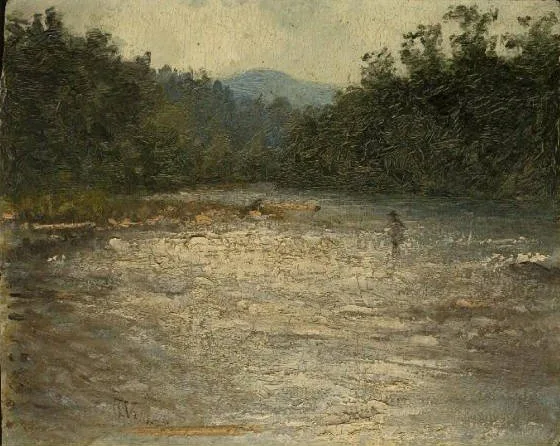
Man Fishing: Attributed to Monet
Comprehensive authentication research on a painting attributed to Claude Monet
Overview
Artist: Attributed to Claude Monet
Medium: Oil on Fiberboard
Dimensions: 22cm x 28cm (8 1/2in x 11in)
Provenance: Private Owner, 1905-2020. Originally purchased with group of four paintings at Closson Art Galleries, Cincinnati, Ohio, 1905.
Closson Art Galleries purchased the picture from Charles T. Webber. Webber was aging, in failing health, in financial difficulty and was selling his art to pay debts. (The Cincinnati Historical Society Bulletin, Vol. 37, Summer 1979, No. 2, Eden Park, Cincinnati, Ohio, 1979, p. 142.)
Provenance Family Statement: It was assumed by all parties including the dealer (Closson), the interior designer and the private owner that the painting was created by C. T. Webber, because this is the name signed on the painting. The private owner purchased it along with three other pictures in 1905. The four pictures have hung as a decorative group since that time, being passed down from one generation to the next.
Signature and Taxation Research
Signature on painting: Webber exhibited at the Paris Salon in 1881 and 1888. He was a realist painting portraits and historical landscapes. (Mary Syre Haverstock, Artists in Ohio 1787-1900, A Biographical Dictionary, p. 916-917, Kent State UP, 2000.)
Why did Webber sign the Monet picture? C. T. Webber signed the study so it could return with him to America, which avoided the tariff duty. Webber was known not only for his art, but also for the academic work organizing Ohio art associations and educating art students. The picture was exhibited by Webber for academic purposes with no intent of selling. During this era many art associations were created and dissolved. The art exhibited by the instructor or academic institution was seldom accounted for, but would often transfer with the instructor to the next association. (Robert C. Vitz, The Queen of the Arts, Kent State University Press, 1989, p. 160.)
Ohio and Paris Connection: Both Theodore Butler (1861-1936, Columbus, Ohio) and Charles Webber (Cincinnati, Ohio) were exhibiting at the Paris Salon in 1881. Butler became Monet's son-in-law in 1892 after Carroll Beckwith (1852-1917, Columbus, Ohio) vouched for Butler's respectability. (Charles Merritt Mount, Monet, A Biography, NY, Simon & Schuster, 1966, p. 347.)
Monet quote: "Sometimes I sell certain esquisses a little more cheaply, but only to friends and artists." Monet felt that such paintings had qualities which made them particularly suitable for fellow artists and for the converted, but that they would do his reputation no good if put on the open market. The 1891 letter shows he continued on occasion to sell or give such esquisses to artists or friends. (John House, Monet Nature into Art, Yale UP, New Haven and London, 1986, p. 159.) Esquisses defined: The first sketch of a picture or model of a statue.
Forensic Research
X-ray (Digital Radiography): The x-ray images were produced utilizing the Statscan in collaboration with LODOX Corporation and Janet G. Smith. The Statscan produced one digital x-ray for the total picture without a composite.
The man fishing figure disappears in the x-ray images. The "Monet" name is not visible on the surface of the painting. "Monet" was not visible until reviewed by x-ray. The rectangle box in the x-ray image pinpoints the artist name.
UV -- Ultra Violet Examination: No preliminary drawing revealed in the image. No recent additions to the picture with the exception of gold retouched frame on the picture in the lower off center right. (The painting has been cleaned and the gold pigment was removed.) "Monet" is faintly visible in the UV image. Swirling brush stroke in the lower left clearly defined. Fishing rod in the composition appears in the UV. "Man Fishing" figure shows in the UV.
Infrared Examination: "Man Fishing" image disappears. "Monet" is faintly visible in the infrared. Crimsons and reds are transparent to infrared, so the "Man Fishing Image" is invisible. The name "CT Webber" is visible.
Microscopic Image Analysis: The microscopic review of the signature "C T Webber" shows the signature was added after the underlying pigment of the water had dried. The dried ridges of the water pigment show in the added artist signature.
Enlarged Image of Man Fishing Figure: The "Man Fishing" figure appears as a small vertical dash of paint in the study. This dash gives the impression of a faint human silhouette. When the digital image is enlarged the small dash of paint becomes a distinct image. This distinct figure of the "Man Fishing" is a bearded man holding a fishing rod and wearing a hat. The position of the fishing pole indicates the fisherman is "fly fishing."
Three years of forensic research by Janet G. Smith with the LODOX Statscan digital x-ray technology has been submitted to the American Institute of Conservation (AIC) in a journal article.
Wall Street Advertisement
The painting "Man Fishing," a small study oil on fiberboard attributed to Claude Monet, was offered for sale. The advertisement ran, expired and was not resubmitted.
Statement of Attribution
I, Janet Gwendolyn Smith, have reviewed the oil on board, titled Man Fishing on numerous occasions from June 2005 through December 2007.
This painting in my opinion is the work of Claude Monet (1840-1926) based upon the x-ray analysis, scientific photographic results, academic research and historic facts about Claude Monet.
The Man Fishing is being represented by the owner as "attributed to the artist" Claude Monet.
-- Janet Gwendolyn Smith, July 10, 2007
Have a similar project? We’d love to hear from you.
Begin a Conversation